
Above the Clouds on Mount Yerer
FIELD VISIT | 26 AUGUST 2026
Witnessing conservation in action and exploring a sustainable future
By Ensermu Workneh | Chairperson, Ethiopian Conservation Trust
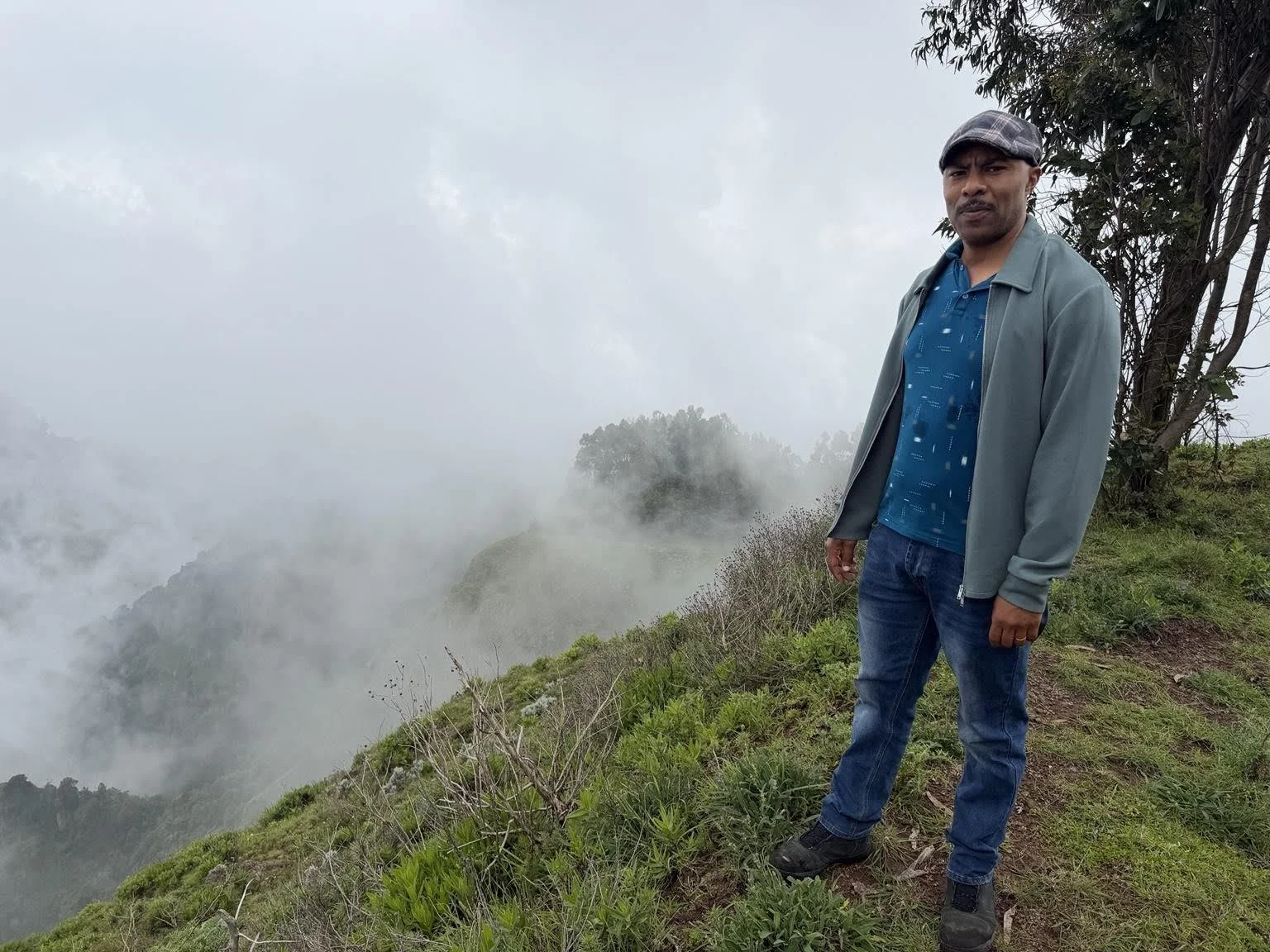
Clouds drifting around the green slopes of Mount Yerer during my visit.
A Journey Worth Making
On 26 August 2026, I had the opportunity to visit the Mount Yerer tree-planting project, an environmental restoration initiative undertaken by Nature Ethiopia in partnership with the Ethiopian Conservation Trust.
The purpose of my visit was to see first-hand the progress made over the previous two planting seasons, assess the project’s achievements and challenges, and discuss opportunities for its long-term sustainability.
I travelled to Mount Yerer with Ato Dekebo Dalle, Director of Nature Ethiopia, accompanied by a member of his team and our experienced driver.
Our vehicle was a 1986 Toyota Land Cruiser. I was surprised that it was still running, especially after learning that it had a history of breaking down. Given the difficult terrain ahead, I was glad it made the journey without breaking down again.
The journey became increasingly challenging once we left the well-maintained asphalt road and began climbing the mountain. The road soon turned into a rough, rocky mountain track. Even with our driver’s experience, the steep climb and uneven terrain made it a demanding journey. At times, the movement of the vehicle left us watching the road and one another rather anxiously.
Eventually, we reached a point where the vehicle could go no further. Together with the director and our driver, I continued on foot towards the planting sites, a walk of approximately 25 to 30 minutes. At one particularly steep section, I had to hold on with both hands as I made my way upwards. It was a demanding climb, but what awaited us near the top made every effort worthwhile.
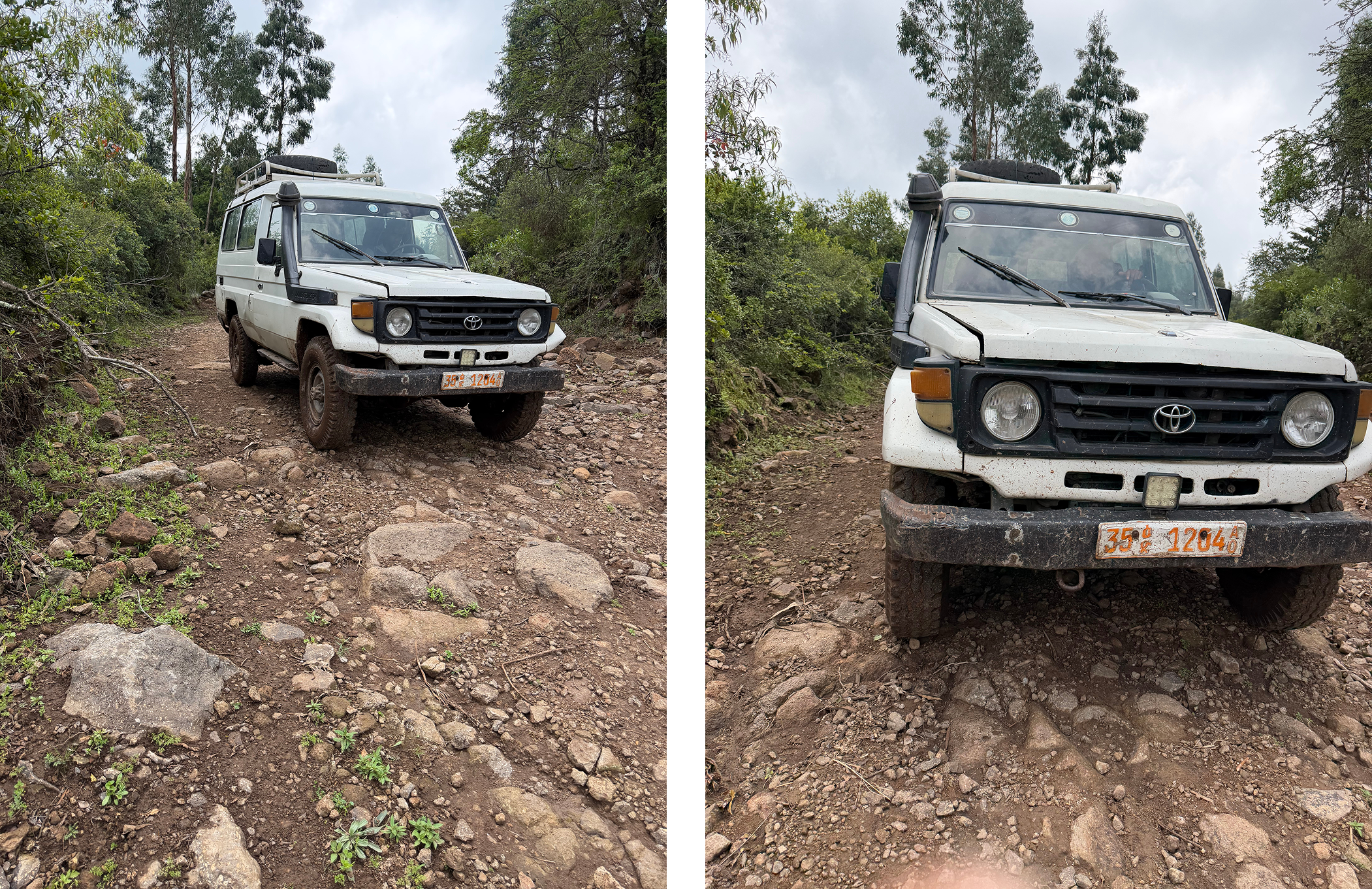
Left: The 1986 Toyota Land Cruiser on the rocky mountain track.
Right: A closer view of the vehicle and the difficult terrain.
Above the Clouds: The Beauty of Mount Yerer
One of the most memorable experiences of the visit was reaching the upper part of Mount Yerer and finding ourselves above the clouds. Thick clouds initially concealed much of the surrounding landscape. As we explored, they gradually thinned and drifted away, revealing the magnificent scenery around us.
The mountain’s majestic beauty slowly came into view. The fresh smell of leaves and vegetation, birds singing, the greenery of the landscape and the refreshing mountain air created an extraordinary atmosphere. It was peaceful, beautiful and deeply refreshing. For a moment, the difficulties of the journey were forgotten.
Standing there, surrounded by nature, I began to appreciate not only the environmental importance of the project but also the remarkable potential of Mount Yerer as a future ecotourism destination.
The idea of developing ecotourism around the restored mountain landscape had already been discussed. Experiencing the place myself convinced me that this was far more than an attractive idea. It was a practical opportunity with the potential to create environmental, social and economic benefits.
Visitors could enjoy guided hiking, explore the natural landscape and potentially stay overnight at designated camping areas, provided that appropriate infrastructure and environmental safeguards are developed. Such activities could generate income to support conservation while creating opportunities for local communities. The mountain itself is a remarkable attraction.
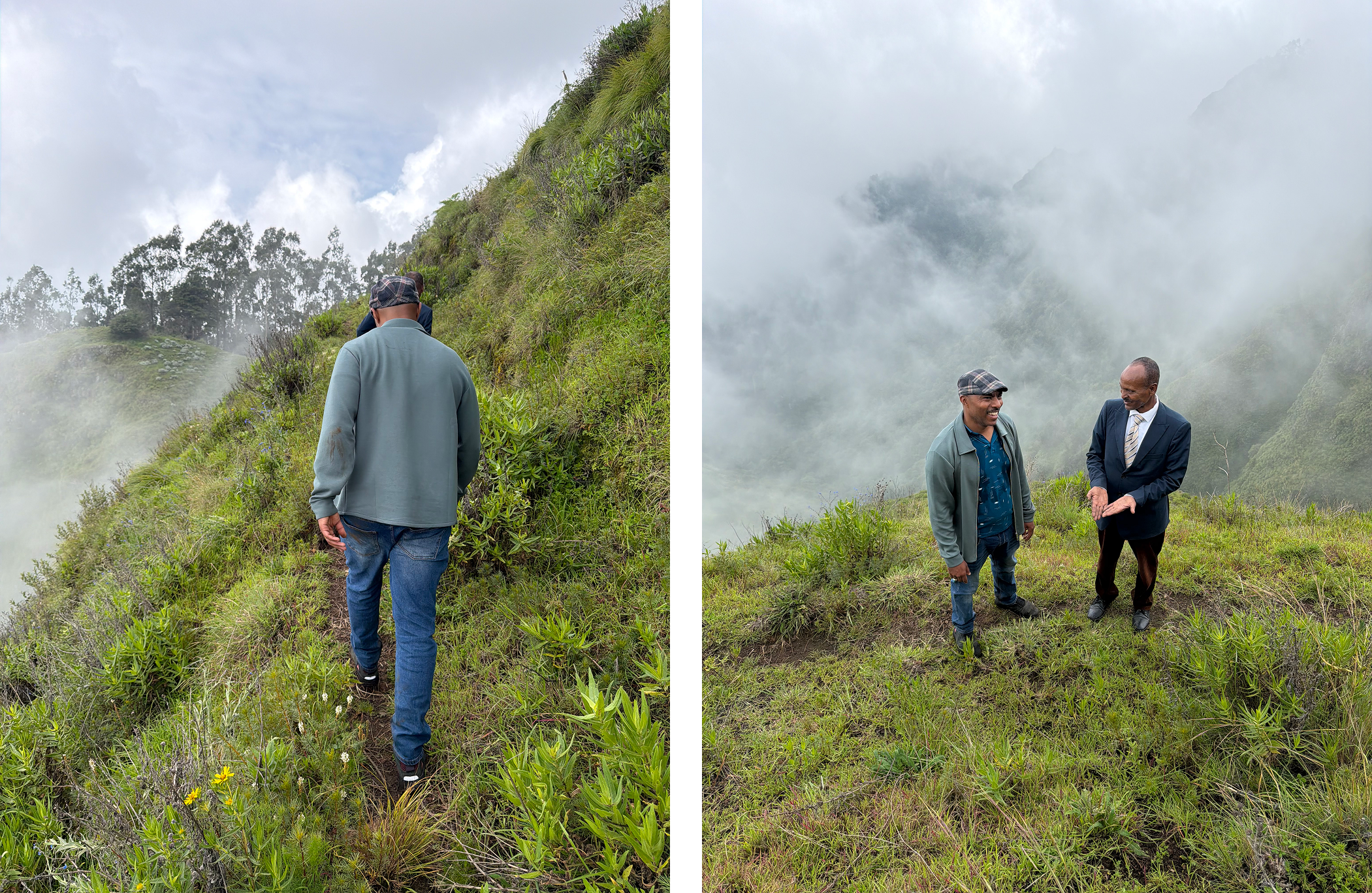
Left: Looking out over the cloud-covered peaks of Mount Yerer.
Right: Discussing the mountain landscape and project areas during the visit.
Nearly 20,000 Trees Planted in Two Seasons
The primary purpose of my visit was to inspect the tree-planting work completed over the previous two summers. During the first planting season in 2025, approximately 13,000 indigenous tree seedlings were planted. In the 2026 planting season, another 6,500 seedlings were added, bringing the total to approximately 19,500 trees planted over two years.
I was particularly pleased to see the progress made in such a relatively short period. As we walked through different sections of the mountain, the director showed me the seedlings planted during the previous year and those added during the most recent planting season. I took hundreds of photographs documenting their growth, the condition of the planting areas and the surrounding environment.
We stayed at the top of the mountain for around an hour and a half, exploring the different parts of the site. Although physically tiring, the experience was both rewarding and refreshing. The team also showed me the areas identified for the next planting season.
According to the information shared during my visit, the land currently being restored was allocated to the project by the Oromia Forest and Wildlife Enterprise (OFWE), which is responsible for managing forests and wildlife resources in the region. I was encouraged to learn that the organisation was supportive of the restoration work and willing to consider allocating additional land once the current planting areas had been completed. This offers an encouraging opportunity for future expansion.
Encouraging Survival Rates and Replanting Efforts
One of the most important measures of a successful tree-planting project is not simply how many trees are planted, but how many survive. The Nature Ethiopia team reported a survival rate of more than 75% among seedlings planted during the first season. They were pleased with this result and explained that seedlings had also been replanted in locations where the original plants had not survived.
I found this particularly encouraging. Planting trees is only the beginning. Their survival, continued growth and eventual contribution to restoring the natural ecosystem are what determine the project’s long-term success.
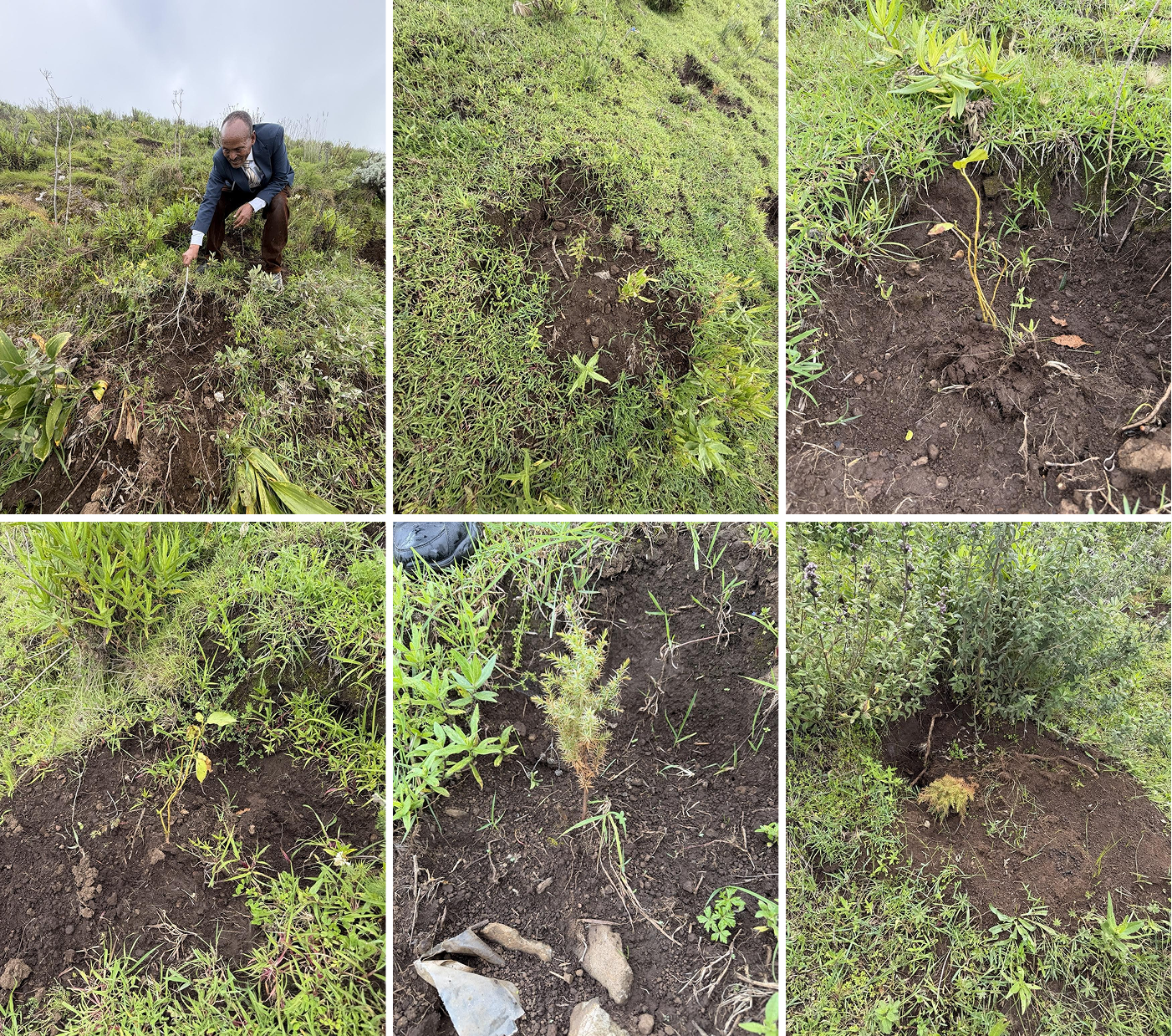
Top row, from left to right: Ato Dekebo Dalle examining a planting area; a planting pit surrounded by young vegetation; a newly planted seedling.
Bottom row, from left to right: A young seedling on the hillside; a small conifer-like sapling; a planting area surrounded by established vegetation.
The team explained how local farmers and volunteers participated in planting, including digging holes, transporting seedlings and planting them during the appropriate season. Having personally experienced the difficulty of reaching the site, I developed an even greater appreciation for the physical effort involved. Walking up the mountain was demanding enough without carrying seedlings and carrying out all the work required during the planting season.
The achievements of the past two seasons are a testament to the dedication of Nature Ethiopia, local farmers, volunteers and everyone supporting the project.
A Disappointing Discovery Along the Road
During our journey up the mountain, I noticed something disappointing. A project signboard displaying the names, logos and details of the Ethiopian Conservation Trust and Nature Ethiopia had been badly damaged. I was told that stones thrown by local schoolchildren had caused the damage.
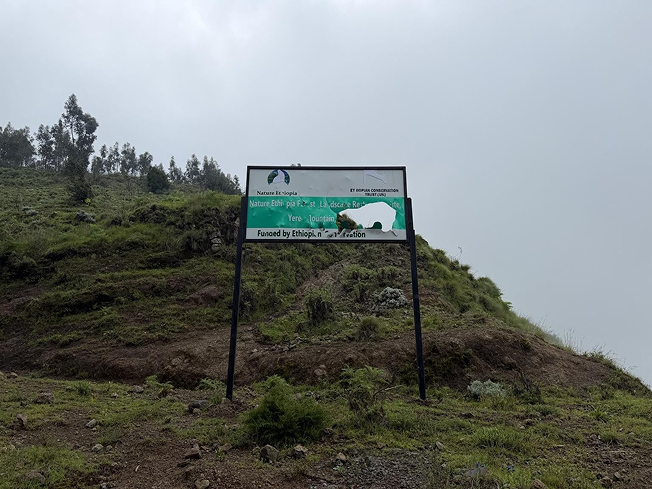
The signboard in its roadside position on Mount Yerer.
The damaged signboard still displays the two partner organisations.
Although the metal frame and supporting poles remained standing, the printed signboard — made from a thick, rigid plastic material rather than metal — had been broken. It was intended to acknowledge the collaboration between the two organisations and inform visitors and the local community about the conservation work taking place on Mount Yerer.
The damage was unfortunate, particularly because the sign represented work intended to benefit the environment and surrounding communities. The team explained that it planned to replace the panel with a more durable metal sheet and move the sign slightly further up the road, to a less exposed location.
Although disappointing, the incident also highlighted the importance of community awareness and engagement. Conservation projects are more likely to succeed when surrounding communities understand their purpose, recognise their benefits and develop a sense of ownership and responsibility towards them.
From the Mountain to the Office: Discussing Sustainability
After completing our visit to the planting sites, we began our journey back down the mountain. The return journey to the Nature Ethiopia office took approximately one hour and fifteen minutes. There, we were joined by other team members, including staff who had travelled from the organisation’s main office and other regional offices. We enjoyed lunch together before moving into a meeting and training session.
The gathering was an opportunity not only to discuss the tree-planting project’s progress but also to explore ways of strengthening Nature Ethiopia’s organisational capacity and creating a more sustainable funding model.
During the session, I shared practical experience from the Ethiopian Conservation Trust, particularly in membership development, donor engagement, marketing and relationship management.
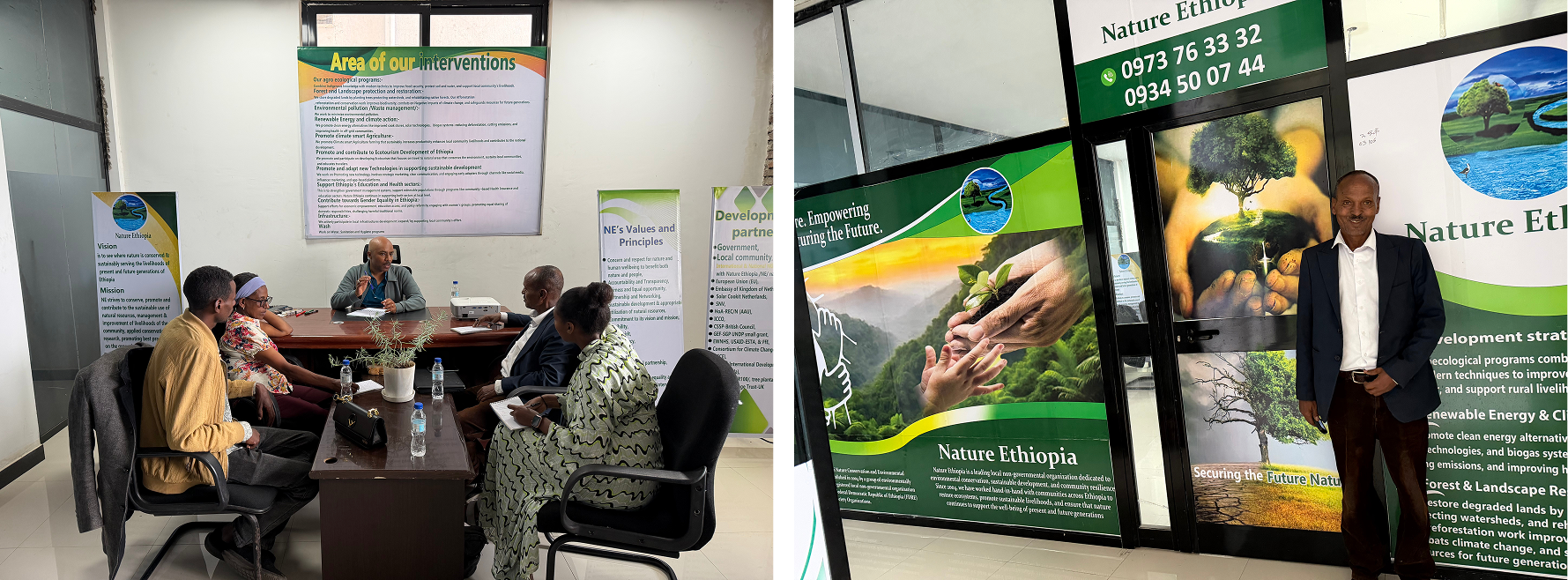
Left: Sharing marketing and donor-development experience with the Nature Ethiopia team. Right: Ato Dekebo Dalle outside Nature Ethiopia’s office.
My central message was straightforward: for conservation projects to become sustainable, they need a reliable base of local members, supporters and donors rather than depending entirely on external financial assistance.
Building a Local Membership and Donor Base
Our discussion focused on practical steps Nature Ethiopia could take to develop its membership and fundraising activities. I explained how we manage our membership and donor database at the Ethiopian Conservation Trust, how we identify potential supporters and how we approach individuals and organisations to establish long-term relationships.
We also discussed the importance of communicating clearly what an organisation does, why its work matters and how supporters benefit from being part of its mission. Fundraising is not simply about asking people for money. It is about helping potential supporters understand the value of a project and giving them meaningful reasons to become involved.
The Nature Ethiopia team welcomed these discussions and found the training valuable. An important outcome of the meeting was their agreement to introduce marketing and membership-development responsibilities within their existing administrative team. Until then, these functions had not been formally incorporated into their administrative activities.
By assigning specific responsibilities and beginning to build a structured membership and donor database, the organisation could develop a more consistent approach to fundraising and community engagement. The team agreed to begin implementing these activities immediately and to share an update on its progress before the next tree-planting season.
Ecotourism: Connecting Conservation and Economic Benefits
One of the most promising areas of our discussion was the proposed development of ecotourism at Mount Yerer. Having experienced the mountain’s beauty myself, I could see considerable potential in this idea.
Ecotourism could attract visitors while generating income that contributes to the protection and restoration of the mountain. It could also give individuals, businesses and organisations an additional reason to support Nature Ethiopia through membership, donations or partnerships.
A well-developed programme could offer visitors opportunities to experience Mount Yerer through hiking, guided tours and carefully managed camping activities. Equally importantly, it could create opportunities for nearby communities through local employment, guiding services and other visitor-related activities.
This was one of the key points I emphasised during our discussion: a conservation project becomes even more compelling when its environmental achievements are accompanied by visible social and economic benefits for the communities around it.
When the benefits of a project are clearly explained and demonstrated, attracting and retaining members, donors and supporters becomes easier. With careful planning, appropriate infrastructure, community involvement and effective marketing, ecotourism could become an important contributor to Mount Yerer’s long-term sustainability.
Strengthening Our Partnership
Following the training session, we concluded our meeting by discussing next steps and the support the Ethiopian Conservation Trust could continue to provide. We exchanged contact details and agreed to remain in communication as Nature Ethiopia begins implementing its marketing and membership-development plans. I also made it clear that I would be happy to provide further advice and guidance whenever needed.
The visit reinforced my appreciation for Nature Ethiopia’s work and the importance of strong partnerships between conservation organisations. Financial support, while essential, is only one part of a successful collaboration. Sharing knowledge, providing organisational guidance, developing local capacity and encouraging financial independence can be equally valuable contributions.
Looking Ahead to January 2027
I concluded my visit feeling encouraged by what I had seen and the discussions we had held. The progress made through the planting of approximately 19,500 trees over two seasons is an important achievement. The reported survival rate, continued replanting efforts and willingness to consider allocating additional land are all positive indicators for the project’s future.
But perhaps the greatest opportunity lies in what comes next. The combination of environmental restoration, community involvement, local fundraising and ecotourism could help transform Mount Yerer into a conservation initiative that continues to grow and sustain itself over many years.
I am planning to return in January 2027. During that visit, I hope to see how Nature Ethiopia has progressed with its membership and donor-development activities, learn more about its plans for ecotourism and review preparations for the next tree-planting season.
Final Reflections
My journey to Mount Yerer was physically demanding, but it was also one of the most rewarding experiences of my visit to Ethiopia. Standing above the clouds, breathing the fresh mountain air, listening to the birds and witnessing thousands of young trees beginning to establish themselves on the mountainside gave me a deeper appreciation of the project we are supporting.
It also reminded me that conservation is not simply about planting trees. It is about restoring natural habitats, protecting biodiversity, involving communities and creating the conditions for nature and people to thrive together.
What I witnessed on Mount Yerer gave me confidence that our partnership with Nature Ethiopia is moving in a positive direction. There is still much to do, but the work already completed provides a promising foundation.
The challenge now is to build on these achievements, strengthen local support and turn a successful tree-planting initiative into a lasting, sustainable conservation project.
I look forward to returning to Mount Yerer and witnessing the next chapter of its restoration.
Ensermu Workneh
Chairperson, Ethiopian Conservation Trust