
Humanity’s place in the natural world
Wisdom from Ethiopian Folktales
Collected across Ethiopia by author and folklorist Elizabeth Laird, these remarkable stories offer a different perspective on humanity's relationship with the natural world.
More than entertaining stories, these folktales invite reflection on stewardship, coexistence, and the wisdom embedded within Ethiopia's rich oral heritage.
The three great Abrahamic religions (Judaism, Christianity and Islam) are central to Ethiopian life and thought, and they permeate in many ways Ethiopia's great store of folktales, even in areas where other religions have long been predominant.
One theme that emerges in several of the stories I collected as part of the British Council and Ministry of Education story collecting project (1) concerns the time of Creation, when God gave the first man and woman dominion over the natural world, and the relationship between humankind and animals was established.
But alongside this concept of domination there are folktales in our collection which describe a close kinship with the animal kingdom. In this lovely Somali story, the well-known narrative of Biblical creation (also referenced in the Koran) is turned on its head and seen from the point of view of the animals. (2)
Here's the story:
When Adam came out of the Garden of Eden into the world, the animals all wondered: "Who is this new being with only two legs? He has two hands, like a monkey, but he's not a monkey. What does he want from us? Can he live peacefully with us?"
They decided to send the dog to talk to him.
The dog approached Adam and said: "You, man, new animal, we are wondering if you will join with us on earth and live peacefully with us, or do you want to fight us?"
"I want to live peacefully," said the man. "I am new and I've come from the garden and I want to live with you."
"Oh, that's good news," said the dog, and he started to run back to the other animals to tell them.
When the other animals saw him running they thought that Adam was chasing him, and they were frightened and began to run away.
The dog tried to tell them not to run away. "Wuf! Wuf!" he barked. "Stop! Stop!"
But the animals were too scared to stop and went on running. From that time, animals have always run away from the man. But the dog turned back and became the man's friend, although he still shouts, "Wuf! Stop!"
And Adam, seeing that the animals ran away from him, thought they didn't want to be his friend. He began to see them as enemies and hunted them, but he asked the dog to stay with him and guard him.
Another story, narrated by the Anuak storyteller Akwai Gora in Gambella, describes how the first man tricked God into giving him power over the animals. It's the buffalo, not the man, who is the favourite of God's creatures. And, as in the Somali story, a starring role is given to the dog.
In the beginning, the man and the animals lived together as friends. Then one day God called them all to Him and said:
"Tomorrow, when the morning star appears and the cock crows, come to me and I will give you your gifts."
Now God said privately to the buffalo: "Come first, as soon as you see the morning star, and I will give you the best gift." He said this because He loved the buffalo best.
But the dog overheard God talking to the buffalo. He ran to the man. "Get up very early, and you will get the best gift."
So the man disguised himself to be like the buffalo by putting rough buffalo hide on his arms, and he went to God before it was light.
"Who are you?" God said.
"I am the buffalo," said the man. "The foster-child of the dogs, brought up by the dogs."
So God gave all the spears to the man. And the man ran away. Then the buffalo came.
"Who are you?" said God.
"I am the buffalo," said the buffalo.
"Then who was it who came earlier?" said God. "I have given him all the weapons. All I can give to you is horns to protect you from the man."
Since that day, the buffalo and all cattle have horns, and they have become servants to the man.
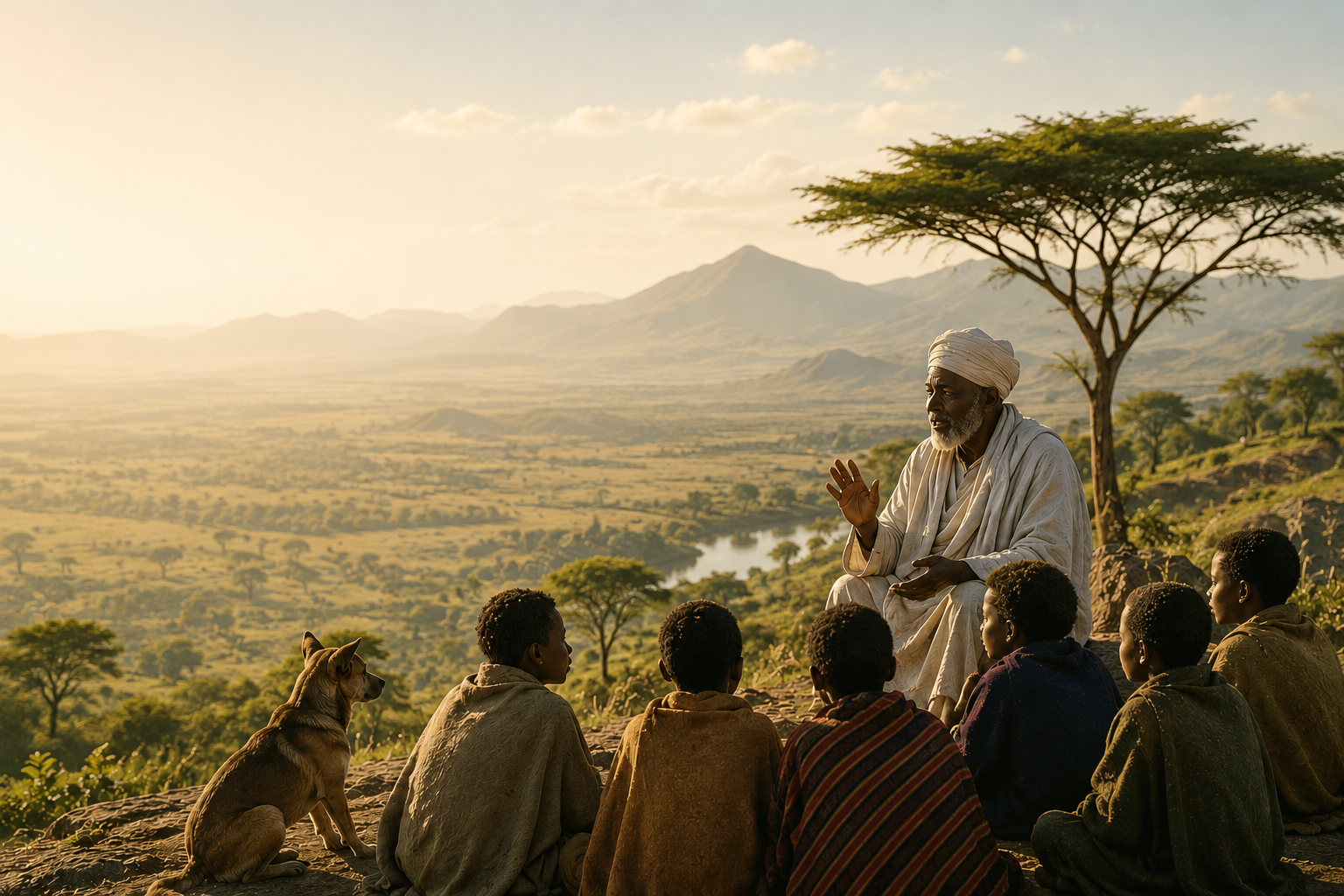
In the West we have lost our respect for folktales. They have been stripped of their old cruelties and repackaged as anodyne children's stories. But I discovered in Ethiopia that the narration of a story, often told in a comfortable place by a river or lake, in the evenings in a tej bet, or after a meal in someone's home, served as the starting point to a discussion.
"And what is the meaning of the story?" someone would often ask when the storyteller had finished speaking.
The ensuing conversation might range wide over questions of morality, politics and local customary laws. Where the story was told in Amharic I could often pick up the bare bones of the plot, but I couldn't follow the discussions. (I regret deeply that my Amharic was so basic.) And of course, when the story was told in one of Ethiopia's eighty or so other languages, I couldn't understand a word. How much I missed! And how foolish I was not to ask more questions, being always in a hurry to rush on to the next place, where another storyteller waited.
There is endless wisdom to unpack from these stories. They were treated with respect by the storytellers (apart from a jolly strain of trickster, scatological and marital mishap stories told for sheer entertainment.) Sometimes gentle arguments would break out when a listener wanted to insist on a more "correct" version.
Do these stories hark back to a time when the Anuak and Somali people were more in harmony with nature? In Ethiopia, as elsewhere in the world, the degradation of the natural world has proceeded with great speed under the pressure of increasing populations and technological advance. Is there a sense of uneasiness? Of regret?
So what is the meaning of these stories? There are many. It's up to you to decide.
Notes
(1) In 1996, the British Council in Ethiopia, under its then Director Michael Sargent, together with the Ethiopian Ministry of Education, established a project to collect stories from traditional storytellers across Ethiopia's many regions. The aim was to produce readers in simplified English so that Ethiopian schoolchildren could improve their fluency while learning and enjoying their own cultural heritage. I was fortunate enough to travel throughout Ethiopia collecting these stories.
(2) This story was collected in Jijiga and narrated by Abdul Hakim Abdulahi Jibril.